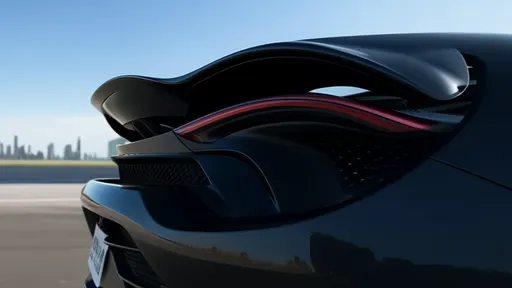
The relationship between vehicle speed and downforce in active aerodynamics represents one of the most critical balancing acts in modern automotive engineering. As speeds increase, the need for stability becomes paramount, and active rear wings have emerged as a sophisticated solution to this challenge. Unlike fixed wings, which provide a constant level of downforce regardless of velocity, active systems dynamically adjust their angle and shape to optimize performance across varying conditions. This adaptability not only enhances grip but also improves efficiency, making them indispensable in both high-performance road cars and competitive motorsports.
At lower speeds, downforce requirements are minimal, as mechanical grip from tires and suspension geometry is sufficient to maintain traction. However, as a vehicle accelerates, aerodynamic forces become increasingly dominant. The air resistance grows exponentially with speed, and without proper management, lift can destabilize the car, reducing tire contact and compromising control. This is where active rear wings come into play. By deploying at predetermined thresholds—often between 80 to 120 km/h—they generate additional downforce to counteract lift, effectively pressing the vehicle onto the road. The result is a seamless transition from efficiency-focused cruising to high-speed stability.
The physics behind this process is rooted in Bernoulli’s principle and Newtonian mechanics. When the wing’s angle of attack increases, it disrupts airflow, creating a pressure differential between the upper and lower surfaces. The higher pressure above the wing pushes downward, while the lower pressure beneath it pulls upward, collectively producing downforce. However, this isn’t a linear relationship. At extreme angles or speeds, airflow can separate from the wing’s surface, leading to stall conditions where downforce collapses abruptly. Advanced systems mitigate this risk through real-time adjustments, often leveraging data from speed sensors, accelerometers, and even GPS to predict optimal configurations.
One of the most groundbreaking aspects of modern active aerodynamics is their integration with hybrid and electric powertrains. In these applications, energy recovery systems can harness excess drag caused by the wing’s deployment, converting it into usable electricity. For instance, during heavy braking, the wing may tilt to its maximum angle, simultaneously increasing downforce for deceleration and feeding energy back into the battery. This symbiosis between aerodynamics and energy efficiency underscores how far the technology has evolved from its purely mechanical origins.
Racing series like Formula 1 and endurance championships have been the proving grounds for active rear wings, but their adoption in consumer vehicles is accelerating. Supercars such as the Porsche 911 GT3 and McLaren Senna employ these systems to deliver track-level performance without sacrificing everyday usability. What’s particularly fascinating is how software algorithms now play a pivotal role. Instead of relying solely on pre-programmed settings, machine learning models can analyze driving patterns, road conditions, and even weather data to anticipate the ideal wing position before the driver consciously demands it.
Looking ahead, the next frontier for active aerodynamics lies in morphing structures—wings that don’t just adjust their angle but transform their entire shape. Imagine a rear wing whose curvature alters microscopically in response to turbulent airflow, maintaining optimal downforce with negligible drag. Such innovations could redefine the limits of speed and efficiency, blurring the line between aerodynamics and artificial intelligence. For now, though, the focus remains on refining existing systems, ensuring they deliver not just raw performance but also reliability and safety at every turn.
Ultimately, the interplay between speed and downforce is a dance of precision, where milliseconds and millimeters determine outcomes. Active rear wings exemplify how engineering ingenuity can tame the chaos of physics, turning what was once a compromise into a symphony of control. Whether on the racetrack or the open road, their impact is undeniable—a testament to humanity’s relentless pursuit of mastering motion.

By /Jun 14, 2025

By /Jun 14, 2025
By /Jun 14, 2025
By /Jun 14, 2025

By /Jun 14, 2025

By /Jun 14, 2025

By /Jun 14, 2025

By /Jun 14, 2025
By /Jun 14, 2025

By /Jun 14, 2025
By /Jun 14, 2025

By /Jun 14, 2025

By /Jun 14, 2025

By /Jun 14, 2025
By /Jun 14, 2025

By /Jun 14, 2025

By /Jun 14, 2025
