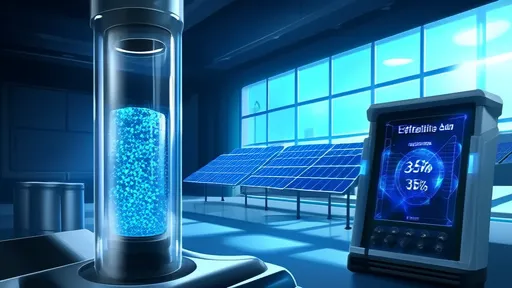
The world of renewable energy has witnessed a groundbreaking achievement as researchers have successfully pushed the efficiency of perovskite solar cells beyond the 35% mark. This milestone represents a significant leap forward in photovoltaic technology, potentially reshaping the future of solar energy. The breakthrough comes after years of relentless experimentation and optimization, addressing some of the most persistent challenges in perovskite solar cell development.
Perovskite solar cells have long been touted as the next big thing in solar technology due to their low production costs and high theoretical efficiency limits. However, until now, their real-world performance has lagged behind traditional silicon-based cells. The recent achievement of 35% efficiency not only surpasses the best silicon solar panels but also opens up new possibilities for ultra-efficient, lightweight, and flexible solar applications.
The research team responsible for this breakthrough employed an innovative tandem cell design, combining perovskite with another photovoltaic material to capture a broader spectrum of sunlight. This approach effectively minimizes energy losses that typically occur in single-junction solar cells, where a significant portion of solar energy is wasted as heat rather than converted to electricity.
What makes this development particularly exciting is the potential for rapid commercialization. Unlike some laboratory achievements that remain confined to research papers, the materials and methods used in these high-efficiency perovskite cells are compatible with existing manufacturing processes. This means we could see these super-efficient solar panels hitting the market much sooner than anticipated.
The implications of this efficiency breakthrough extend far beyond just better solar panels. At 35% efficiency, perovskite solar cells become viable for applications where space is at a premium, such as electric vehicles, portable electronics, and even building-integrated photovoltaics. The lightweight nature of perovskite cells could revolutionize how we think about solar energy collection, enabling installations on surfaces previously considered unsuitable for traditional panels.
One of the most persistent criticisms of perovskite technology has been its relative instability compared to silicon. However, the research team has made significant strides in addressing this issue as well. Through advanced encapsulation techniques and material engineering, they've demonstrated cells that maintain their high efficiency for extended periods under real-world operating conditions.
The environmental benefits of this advancement cannot be overstated. Higher efficiency means more energy can be generated from the same surface area, reducing the land use requirements for solar farms. Additionally, the lower temperature coefficient of perovskite cells compared to silicon means they perform better in hot climates, potentially expanding solar energy's geographical reach.
Industry analysts predict that this efficiency breakthrough could accelerate the global transition to renewable energy. With production costs potentially lower than silicon and now superior performance, perovskite solar cells may quickly become the dominant photovoltaic technology. Several major solar manufacturers have already announced plans to scale up perovskite production in light of these developments.
Looking ahead, researchers are optimistic about pushing efficiencies even higher. Theoretical models suggest that with further refinements to the tandem cell architecture and continued improvements in material quality, perovskite solar cells could eventually reach 40% efficiency or beyond. This would make them competitive with the most efficient multi-junction cells used in space applications, but at a fraction of the cost.
The scientific community has greeted this achievement with cautious optimism. While celebrating the efficiency milestone, experts emphasize the need for continued research into long-term durability and large-scale manufacturing consistency. Nevertheless, the 35% barrier has been broken, marking what many believe will be remembered as a turning point in solar energy history.
As governments worldwide intensify their climate change mitigation efforts, timing of this breakthrough couldn't be better. The increased efficiency comes just as global investments in renewable energy infrastructure are reaching record levels. Policy makers are now faced with the exciting challenge of adapting energy strategies to account for this unexpectedly rapid advancement in solar technology.
For consumers, the practical implications are profound. Higher efficiency solar panels mean shorter payback periods for residential installations and potentially lower electricity bills. The flexibility of perovskite cells also opens up creative new possibilities for integrating solar power collection into everyday objects and building materials.
The road from laboratory breakthrough to widespread adoption still has hurdles to overcome, but the 35% efficiency milestone serves as powerful validation of perovskite's potential. As research continues and manufacturing processes mature, we may be witnessing the dawn of a new era in solar energy - one where ultra-efficient, affordable photovoltaics become ubiquitous in our energy landscape.

By /Jun 20, 2025

By /Jun 20, 2025
By /Jun 20, 2025

By /Jun 20, 2025

By /Jun 20, 2025

By /Jun 20, 2025

By /Jun 20, 2025

By /Jun 20, 2025

By /Jun 20, 2025

By /Jun 20, 2025

By /Jun 20, 2025

By /Jun 20, 2025

By /Jun 20, 2025

By /Jun 20, 2025

By /Jun 20, 2025

By /Jun 20, 2025

By /Jun 20, 2025
