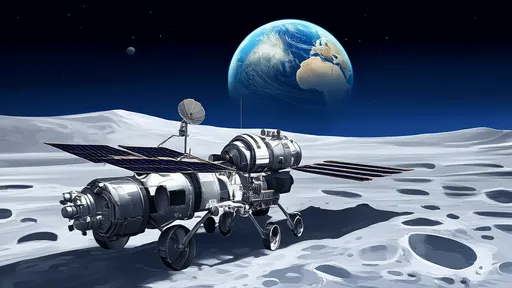
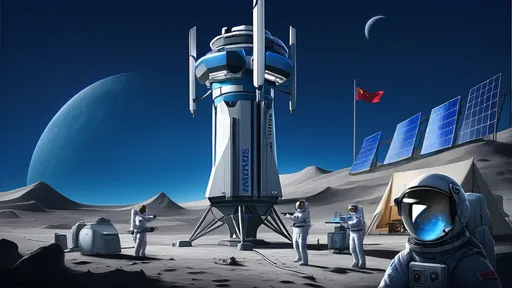
In a groundbreaking leap for space exploration and telecommunications, the world’s first 4G network has been activated on the Moon. The network, powered by Nokia’s cutting-edge technology, is set to support China’s ambitious Chang’e lunar missions, including the planned construction of a lunar research base. This milestone marks a significant step toward sustainable human presence beyond Earth, with reliable communication infrastructure now in place on the lunar surface.
The project, a collaboration between Nokia Bell Labs, the Chinese space agency, and other international partners, demonstrates the growing synergy between space exploration and commercial technology. The 4G network, designed to withstand the Moon’s harsh environment—extreme temperatures, radiation, and vacuum—will facilitate high-speed data transmission between lunar landers, rovers, and future astronauts. Unlike traditional space communication systems, which rely on direct links to Earth, this localized network promises faster, more efficient operations for scientific experiments and habitat management.
Why 4G, and Why Now?
The choice of 4G over newer 5G technology might seem surprising, but it was a deliberate decision driven by reliability and power efficiency. Lunar missions demand systems that can operate with minimal energy consumption while maintaining robust performance. Nokia’s 4G solution, adapted from terrestrial networks, offers a proven, stable framework that consumes less power than 5G—a critical factor given the limited energy resources available on the Moon. Additionally, the lower frequency bands used in 4G provide better penetration and coverage in the Moon’s rocky, uneven terrain.
The deployment was executed autonomously by the Chang’e lander, which carried the compact, lightweight base station to the lunar surface. Once activated, the network established connections with the Yutu-2 rover and other assets, enabling seamless data exchange. This success paves the way for more complex infrastructure, including future 5G upgrades, as lunar activities expand.
The Chang’e Lunar Base: A Communication Backbone
China’s long-term vision for the Moon includes the International Lunar Research Station (ILRS), a collaborative base planned for the 2030s. The 4G network will serve as the communication backbone for this endeavor, supporting everything from habitat monitoring to remote-controlled robotics. Scientists emphasize that real-time data transmission is essential for tasks like drilling, sample analysis, and even emergency response—capabilities that were previously hampered by communication delays with Earth.
Beyond practical applications, the network’s success has symbolic weight. It underscores the Moon’s transition from a destination for sporadic visits to a hub for sustained human activity. As private companies and nations race to establish lunar outposts, reliable communication will be as vital as water or oxygen. Nokia’s involvement also highlights the increasing role of private-sector innovation in space, where terrestrial technologies are repurposed to meet extraterrestrial challenges.
Challenges and Future Prospects
Despite the triumph, maintaining a lunar network presents unique hurdles. Dust accumulation on solar panels, cosmic radiation, and the lack of atmospheric shielding can degrade equipment over time. Nokia’s engineers have incorporated radiation-hardened components and self-healing software to mitigate these risks, but long-term durability remains untested. Future iterations may require modular designs for easy repairs or replacements by astronauts.
Looking ahead, the project’s stakeholders envision a lunar internet—a mesh of interconnected nodes supporting multiple bases and missions. Such a system could eventually integrate with Earth’s networks, creating a seamless interplanetary communications web. For now, the focus remains on scaling up capacity to support the Chang’e program’s next phases, including crewed missions and the ILRS construction.
The activation of the Moon’s first 4G network is more than a technical achievement; it’s a glimpse into humanity’s multi-planet future. As Nokia’s equipment hums quietly on the lunar surface, it whispers a promise: the cosmos is no longer out of reach, and the tools we’ve built on Earth can help us thrive among the stars.

By /Jun 20, 2025

By /Jun 20, 2025
By /Jun 20, 2025

By /Jun 20, 2025

By /Jun 20, 2025

By /Jun 20, 2025
By /Jun 20, 2025

By /Jun 20, 2025
By /Jun 20, 2025
By /Jun 20, 2025

By /Jun 20, 2025

By /Jun 20, 2025

By /Jun 20, 2025

By /Jun 20, 2025

By /Jun 20, 2025

By /Jun 20, 2025
By /Jun 20, 2025
