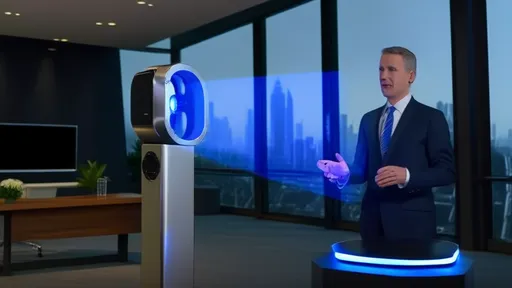
Google has taken a significant leap forward in the realm of immersive communication with the launch of Project Starline 2.0, a next-generation holographic video conferencing system designed to bring lifelike interactions to businesses and consumers alike. The upgraded platform promises to revolutionize remote collaboration by eliminating the flat, two-dimensional constraints of traditional video calls, replacing them with a three-dimensional experience that makes participants feel as though they’re sitting across from each other in the same room.
The original iteration of Project Starline, unveiled in 2021, was an ambitious prototype that relied on custom-built hardware, advanced depth sensors, and AI-driven rendering to create photorealistic holograms. While impressive, the system’s high cost and technical complexity made it impractical for widespread adoption. With Starline 2.0, Google has streamlined the technology, reducing its footprint and leveraging advancements in machine learning and compression algorithms to make it commercially viable.
At the heart of Project Starline 2.0 is a refined approach to capturing and transmitting spatial data. Instead of relying on bulky camera arrays and specialized lighting, the new system uses off-the-shelf hardware combined with proprietary software to reconstruct 3D imagery in real time. This shift not only lowers production costs but also simplifies deployment, allowing businesses to integrate the technology into existing conference rooms with minimal setup.
One of the most striking improvements in this version is the reduction in bandwidth requirements. Early demonstrations of holographic communication often demanded gigabit-level connections, making them inaccessible for many organizations. Google claims that Starline 2.0 can now deliver seamless holographic calls over standard enterprise internet connections, thanks to breakthroughs in data compression and latency optimization. This development opens the door for global enterprises, remote teams, and even healthcare providers to adopt the technology without overhauling their infrastructure.
The implications for industries reliant on face-to-face interaction are profound. In sectors like design, engineering, and medicine, where spatial awareness and nuanced communication are critical, Project Starline 2.0 could eliminate the need for costly travel while preserving the fidelity of in-person collaboration. Imagine architects reviewing 3D blueprints together as if standing over the same drafting table, or surgeons consulting on a procedure with a colleague who appears to be right beside them—all without leaving their respective offices.
Google’s push to commercialize the platform comes at a time when hybrid work models have become the norm, yet many employees and employers remain dissatisfied with existing video conferencing tools. Traditional solutions like Zoom or Microsoft Teams, while functional, often fail to replicate the spontaneity and depth of physical meetings. Starline 2.0 aims to bridge that gap by restoring eye contact, natural gestures, and a sense of shared space—elements that are frequently lost in pixelated grids of faces on a screen.
Early adopters testing the system report a dramatic difference in engagement during calls. Unlike conventional video chats, where participants may multitask or disengage, the immersive nature of holographic communication demands attention and fosters a stronger sense of presence. This could lead to more productive meetings, sharper decision-making, and even improved workplace relationships, as remote colleagues interact in a way that feels fundamentally human.
Despite its promise, Project Starline 2.0 still faces hurdles before achieving mass adoption. Pricing details remain undisclosed, though industry analysts speculate that initial deployments will target high-value corporate clients rather than individual consumers. There’s also the question of interoperability—whether Google will open the platform to third-party developers or keep it confined within its ecosystem, as it has with other enterprise offerings.
Privacy and data security present another layer of complexity. Transmitting detailed 3D representations of individuals requires robust encryption and clear policies on how biometric data is stored. Google has assured early partners that Starline 2.0 adheres to stringent security protocols, but public skepticism around tech giants handling sensitive information persists, particularly in regulated industries like finance and healthcare.
Looking ahead, the success of Project Starline 2.0 may hinge on its ability to evolve beyond boardrooms and into everyday life. While businesses are the obvious first adopters, Google has hinted at future consumer applications—perhaps a pared-down version for home offices or integration with augmented reality glasses. The company’s long-term vision appears to be a world where holographic communication is as commonplace as smartphone video calls are today.
For now, the launch of Starline 2.0 marks a pivotal moment in the convergence of AI, telecommunications, and spatial computing. It challenges the status quo of remote interaction, offering a glimpse into a future where distance is no longer a barrier to meaningful connection. As pilot programs roll out in select Fortune 500 companies and academic institutions over the coming months, the tech industry will be watching closely to see if this bold experiment can transition from dazzling demo to indispensable tool.

By /Jun 20, 2025

By /Jun 20, 2025
By /Jun 20, 2025

By /Jun 20, 2025

By /Jun 20, 2025

By /Jun 20, 2025

By /Jun 20, 2025

By /Jun 20, 2025

By /Jun 20, 2025
By /Jun 20, 2025
By /Jun 20, 2025
By /Jun 20, 2025

By /Jun 20, 2025

By /Jun 20, 2025

By /Jun 20, 2025

By /Jun 20, 2025
By /Jun 20, 2025
